
Environmental Governance
The Environmental Governance programme seeks to ensure that indigenous and forest peoples have full access to and control over their lands and territories, upholding their customary relationships based on diverse cultures and spirituality, practices and innovations and care for nature.
In this programme
-

Territorial Governance
Through our work on Territorial Governance, we seek to innovate and implement mapping, monitoring and management tools.
-

Culture and Knowledge
Our work on Culture and Knowledge aims to ensure that the communities we work with can live according to their traditional practices, using their languages and on their ancestral lands.
-

Conservation and Human Rights
Our Conservation and Human Rights work supports indigenous peoples and forest peoples to assert their rights to own, occupy, protect, and conserve their ancestral land and territories according to their knowledge and skills.
Further info
The Environmental Governance Programme supports the development of innovative strategies to amplify the voices of indigenous peoples and forest peoples in solving the biodiversity and climate crisis by enabling and demonstrating community-led conservation in challenging environments, by documenting and championing indigenous knowledge systems that protect biodiverse systems, by fostering collaboration in indigenous-led education and transmission of local ecological knowledge, and by building models of mapping support that can upset imbalanced power relations and turn the tide against expanding industrial agriculture in pristine areas.
Context
In many countries, indigenous peoples and forest peoples do not have official ownership of their lands. This can be due to the creation of National Parks, a lack of political will to process land tenure requests, extractive industries encroaching on forest peoples’ lands, and more. Yet these communities have cared for their lands for generations and rely upon them for their foods, medicines, and cultures.
Evidence shows that indigenous peoples – with secure land tenure – are often the best at caring for, conserving, and restoring nature. However, their participation in decision-making and management of these areas is too often severely limited, leaving them vulnerable to rights violations, evictions and land grabbing.
We are part of the land and part of the water. Indigenous Peoples must be the ones to guide us forward in protecting, conserving, and stewarding our environment".
Aims
We support indigenous peoples and forest peoples who are facing such challenges to understand and protect their rights, negotiate better recognition of their rights to their territories, and ensure their involvement in, and ideally control over, the management of conservation projects on their lands. Our work is supported by a core grant from Arcadia Fund which underpins work across the programme.
Every member of our community depends and continues to depend on the forest. It is she who makes our identity. She is our soul, without it we have no life, we disappear.”
Our Work
FPP works with indigenous peoples and forest peoples, and with their communities, to:
- Document, strengthen, and transmit their traditional knowledge to future generations and continue to defend and develop sustainable livelihoods where they are threatened. We also create space to advocate for recognition of their customary practices in national and international spheres. We do this through promoting cultural and ecological resilience with partners and advancing recognition of the diversity of cultural and biological knowledge. This includes integrating indigenous and local knowledge into biodiversity monitoring at the community and territorial level, as in the Transformative Pathways partnership.
- Map and monitor cultural and biological diversity, land uses, and traditional knowledge on their lands and waters using new technologies, including GPS satellite tools. This provides valuable data for the community to use for their own territorial monitoring and to present to authorities as evidence of their efforts to protect and conserve the land. Mapping and monitoring work combines culturally appropriate new technologies with patterns of traditional knowledge use. We also support communities and peoples in monitoring human rights outcomes in their communities and lands through a global collaboration, the Indigenous Navigator.
- Advance self-determined conservation initiatives by supporting communities to gain recognition for the conservation they have practiced for decades and collaborate with conservation organisations where possible to advance their land rights struggles. With partners, we act to improve global practice on conservation, including prioritising rights and equity in the creation and management of national parks and other area-based conservation measures. We seek accountability and redress for violations, working with the Legal and Human Rights Programme and the Whakatane Mechanism, and we celebrate and document how communities and peoples are transforming conservation practices.
- Engage in international laws and standards by supporting communities and leaders to attend and actively engage in international processes such as the Biodiversity and Climate Conventions, and global conservation policy spaces like the International Union for the Conservation of Nature (IUCN). Indigenous and forest peoples’ voices have long helped shape international policy in creative and ground-breaking ways. This includes partnering with the Responsible Finance Programme in work on global financing for Indigenous Peoples and local communities, advocating for increased direct financing, and engaging with emerging biodiversity and nature markets to ensure critical information provision and analysis is provided to communities.
Conservation Pathways
The new Biodiversity Framework creates an opportunity for Indigenous Peoples and local communities to redefine conserved areas in line with their self-determined priorities and cultures.
Latest resources

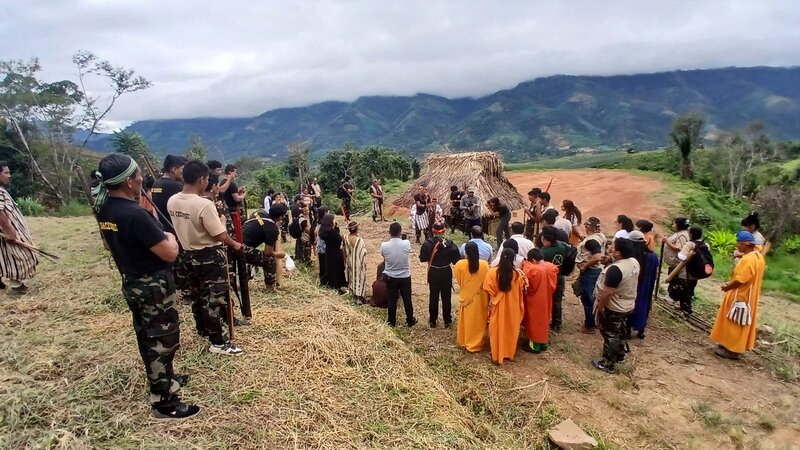


Réforme foncière, conservation de la nature et droits des peuples autochtones au cœur du dialogue en République démocratique du Congo
14 May 2026
Territorial GovernanceCulture and KnowledgeConservation and Human RightsLegal EmpowermentLaw and Policy ReformLands, Territories and ResourcesSelf Determination and FPICRights to Lands, Territories and ResourcesSelf-determinationFree, Prior and Informed Consent (FPIC)
Land reform, conservation and Indigenous rights at the heart of Democratic Republic of the Congo talks
12 May 2026
Territorial GovernanceConservation and Human RightsLegal EmpowermentLaw and Policy ReformLands, Territories and ResourcesSelf Determination and FPICBiodiversityRights to Lands, Territories and ResourcesSelf-determinationFree, Prior and Informed Consent (FPIC)

