

Feeling the Squeeze: Land concentration and corporate capture in food systems
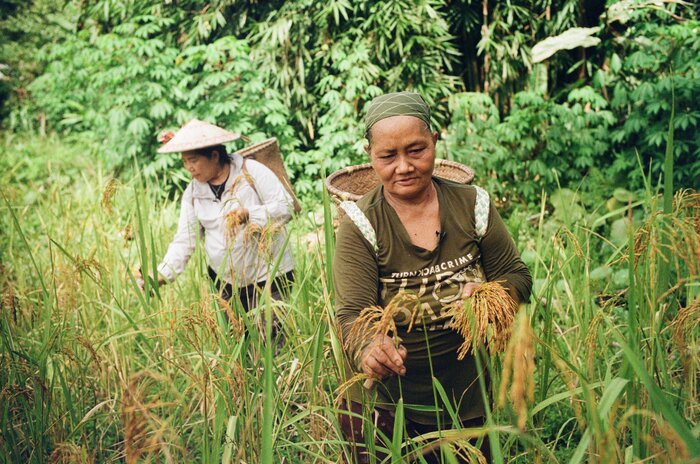
This is first article in a Forest Peoples Programme series on alternative food systems and linked to our webinar series ‘Cultivating Resilience’. The quotations in this article include some from the speakers at our first webinar. For the full recording of the webinar, see below.
Access to land is a crucial part of people’s (and peoples’) lives around the globe. Essential for the livelihoods and food security of billions, land also carries deep ties to people’s cultural identity. For many Indigenous Peoples and forest peoples, but also many other communities across the world, connections to their lands have shaped the lives of their communities for generations.
However, in recent decades access to land has been threatened by an increasing concentration of farmland in the hands of fewer people. Pressures on land have been rapidly increasing. Globally, small farms (under 5 hectares) are rapidly disappearing and large farms (over 100 hectares) control increasing amounts of farmland.
Among the many reasons for this are land-grabbing of customary lands by private and state actors as well as the increased consolidation of farms to enable industrial farming. Relatedly, smaller farms are increasingly economically unviable - or socially unviable, as youth move elsewhere. Land consolidation is often significantly influenced by government policies on agriculture, trade deregulation, and ‘financialisation’ of farmland – that is, investing in farmland as a financial asset, seeking returns, rather than farmland being owned by those who work it – that drives land prices up.
This is not an isolated issue - land inequality has been on the rise everywhere. Across the world, 1% of the world’s largest farms control 70% of farmland, while 84% of farms control only 12% of farmland[1]. In the EU, only 3.6% of farms control areas of 100 hectares and more, but they account for more than half of the total farmland area in Europe (52.5%). At the same time, between 2005 and 2020 approximately 4.6 million small farms disappeared in the EU[2].
“Access to land is also very difficult in the Netherlands. Land is very expensive; it’s one of the most speculative countries in Europe”
Anne van Leeuwen, Regenerative Farmer, t’Gagel Farm - Netherlands
This pattern is repeated around the world. In Latin America, the number of mega farms controlling thousands of hectares has been rising: an analysis of 15 countries in the region found that 1% of the biggest farms controlled more than half of farmland.[3] In South Asia, the largest 5% of farms control 30% of farmland while the smallest 80% of farms (under 2 hectares) control only 40%[4]. While typical farm size and the speed of change varies between regions, the direction of change is remarkably consistent across regions.
[1] Anseeuw, W., & Baldinelli, G.M. (2020). Uneven ground: land inequality at the heart of unequal societies. ILC & Ox fam.
[2] Eurostat (2022). Key figures on the European food chain – 2022 edition.
[3] Oxfam. (2016). Unearthed: Land, Power and Inequality in Latin America.
[4] IPES-Food, 2024. Land Squeeze: What is driving unprecedented pressures on global farmland and what can be done to achieve equitable access to land?

As farm sizes get bigger and fewer people control more land, we all suffer. Concentration of land means that smaller farmers, Indigenous Peoples, local communities – those who have the most sustainable, secure and health-giving food systems - are pushed out, sometimes violently. They no longer have land for producing food, for securing their own livelihoods and sustaining their communities. Poverty in rural areas increases, and food security and food sovereignty of those who rely on local food markets is reduced. Locally-produced, nutritious food is often replaced with mass-produced, highly processed alternatives; local food traditions decline, and sustainable agricultural traditions do too. Efforts to maintain, develop or revitalise more local and sustainable food production are replaced by industrial farms that are more reliant on fossil-fuel and pesticide intensive agriculture and have significantly higher impacts on climate and nature.
“Our forest is poorer and poorer every time and it forces us to go to the city market because it is becoming more difficult for us to catch fish and it obliges us to travel more and further for food. This implies that we have not has much protein and vitamins from the food we eat.”
Rolando Escobar, Vice President of the Federation of Indigenous Communities of Ucayali and its Tributaries (FECONAU) - Peru
This widespread loss of access to farmland for smaller food producers, including Indigenous Peoples, small farmers, smallholders, and local communities has far reaching consequences for our global food production. Impacts inevitably ripple across our societies and threaten the wellbeing of our communities. Less healthy foods take over our diets, poverty spreads among those that feed us, our ecosystems and our biodiversity are destroyed, and our climate continues to worsen. But there are alternatives, and we need to work together to shift in that direction.
“It’s beautiful to see how agroecology brings back activity and life within communities, and helps build back a new world”
Jean-François Simonin, Terre de Liens - France
“Social, economic and ecological impacts go hand in hand. I never knew with the world view I grew up with that everything could thrive together. And it’s something that Indigenous Peoples have known for longer”
Anne van Leeuwen, Regenerative Farmer, t’Gagel Farm - Netherlands
In Forest Peoples Programme’s new webinar series “Cultivating resilience”, we explore how farmers and food systems workers, including Indigenous Peoples and forest peoples, are affected by similar challenges in our current food system, and how they use innovative knowledge and practices to develop more sustainable modes of food production across continents. Our first episode “Feeling the Squeeze: Land concentration and corporate capture in food systems” brought together small farmers from the EU, as well as Indigenous Peoples from Latin America and South-East Asia, to discuss the various ways their communities are affected by increasing loss of access to farmland. The recording for this knowledge exchange is below.
Overview
- Resource Type:
- News
- Publication date:
- 29 abril 2026
- Region:
- Peru Indonesia Netherlands
- Programmes:
- Territorial Governance Climate and Forest Policy and Finance
- Partners:
- Federacíon de Comunidades Nativas del Ucayali y Afluentes (FECONAU) Perkumpulan Nurani Perempuan (PNP)

