

Victory in the face of judicial criminalisation: the case against the Kichwa community of Puerto Franco, Peru, has been definitively dismissed
This article was first published in Spanish on idl.org
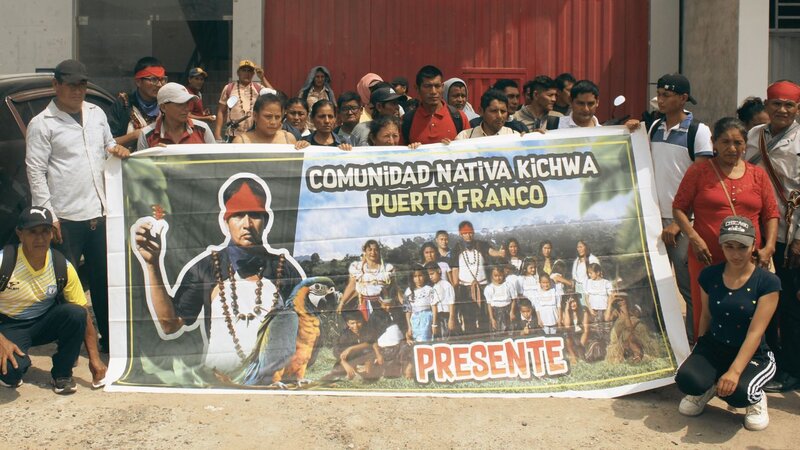
In a landmark ruling for the defence of Indigenous rights, The Preliminary Investigation Court of Huallaga, located in the San Martín region of Peru, has ordered the permanent dismissal of the criminal case against Henrry Fasabi Tuanama, the Apu of the Puerto Franco Indigenous community, and lawyer Olga Cristina del Rocío Gavancho León.
The proceedings, which sought to punish the defenders on charges of obstruction of justice, have been closed following confirmation that no crime was committed.
This case sparked a wave of outrage and solidarity both nationally and internationally. More than 70 organisations, led by the Inter-Ethnic Association for the Development of the Peruvian Rainforest (AIDESEP), issued a public statement rejecting what they described as a ‘criminalisation strategy’ by the Specialised Environmental Prosecutor’s Office (FEMA) in Moyobamba.
The organisations denounced the Public Prosecutor’s Office for attempting to use criminal law to intimidate the community of Puerto Franco in the context of its long-standing struggle to title its ancestral territory, which overlaps with the Cordillera Azul National Park (PNCAZ).
However, the recent court ruling upheld the arguments of the defence and civil society, highlighting key points that undermined the prosecution’s case. One of these is the absence of criminal intent, as the restriction of access to the authorities on 25 April 2024 was not an arbitrary act, but a response to the lack of proper notification and a demand for respect for the right to prior consultation.
Furthermore, based on reports from OSIPTEL (the government authority on telecommunications), the court concluded that there is no phone signal in the area, thereby invalidating the accusation that lawyer Gavancho gave instructions to obstruct the proceedings.
Likewise, the judge determined that the facts do not constitute a criminal offence and that, rather, they stem from a conflict of understanding between the State and a community that perceives the proceedings as a threat to its territorial interests.
Persistence of criminalisation
However, although justice prevailed in the first case, it has not yet been fully realised. In a worrying turn of events, a new investigation has been launched based on the same facts, but in a different jurisdiction and under a different legal classification. On this occasion, Cristina Gavancho and Henrry Fasabi Tuanama are been charged with the alleged offences of violence and resisting authority, as well as actual concealment to the detriment of the State, the Public Prosecutor’s Office and the PNCAZ.
For its part, the Public Prosecutor’s Office has described this new case as “complex”, setting a preliminary investigation period of eight months—a decision that is disproportionate and unsubstantiated. The prosecution file does not meet the necessary criteria to justify such an extension, nor does it present any new evidence that would warrant prolonging the legal uncertainty of those under investigation. In response, the defence has filed a constitutional appeal before the Preliminary Investigation Court, seeking an assessment of the timeframe and questioning whether a prosecutorial decision should be issued within a shorter timeframe.
Furthermore, both Apu Fasabi Tuanama and lawyer Gavancho León have complied with the requirement to provide their statements and have submitted documentation that conclusively proves the absence of criminal liability in relation to the acts attributed to them. In this regard, and considering that the first case concerning the same facts has already been definitively closed, it is expected that this new investigation will follow the same line of legal reasoning.
Información General
- Tipo de recurso:
- Noticias
- Fecha de publicación:
- 27 marzo 2026
- Región:
- Perú
- Programas:
- Acceso a la justicia
- Socios:
- Asociación Interétnica de Desarrollo de la Selva Peruana (AIDESEP)
