
Addressing illegal fishing and offshore oil extraction in Suriname: Kaliña fishing association secures its seat at the table
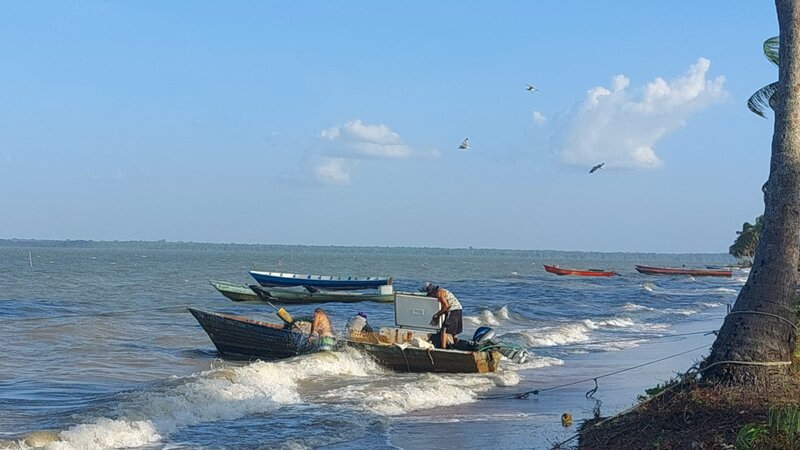
For the Kaliña people of Galibi, on the north-eastern tip of Suriname, fishing is a way of life deeply entwined with their culture, local economy, and the health of their territorial waters.
But the sustainability of Galibi’s fish stocks and the Kaliña way of being are under increasing pressure from illegal fishing, polluting boats from Guyana and Brazil, dead fish washing up on shore, and the prospect of offshore oil extraction following the discovery of huge off-coast oil reserves in 2020.
The community had been raising these concerns with authorities for years, without result, until a breakthrough occurred in 2025.
The Galibi fishermen’s association, Woto Poko Noko, has been steadily building its capacity to monitor fish stocks, develop community-based fishing plans, and generate a sustainable community income, with support from the Association of Indigenous Village Leaders in Suriname (VIDS), backed by FPP’s long-term SwedBio-funded partnership on cultural and biological diversity.
It has also been pushing for the Surinamese fisheries ministry to more seriously consider the knowledge and experience of its members, and afford them a greater say in regional and national fisheries decision-making, based on the principles of free, prior and informed consent (FPIC).
On 1 April 2025, following years of advocacy and capacity strengthening, Woto Poko Noko signed a formal agreement with the fisheries ministry securing the association’s direct participation in the development of two regional fisheries projects being developed in collaboration with the Food and Agriculture Organisation (FAO). At Woto Poko Noko’s insistence, the ministry agreed that the principles of FPIC would be applied. The agreement was signed only after ministry representatives visited Galibi to present the plans, and the village councils and communities discussed and consented to the proposals.
This outcome stands in stark contrast to events from just a year earlier, when Woto Poko Noko was asked to attend a validation meeting for a national plan of action to tackle illegal, unreported and unregulated fishing, despite the community having no involvement in developing the project. Woto Poko Noko, VIDS, and a delegation of chiefs from the Lower Marowijne region highlighted that the project had been designed without community involvement, in breach of the FAO’s own FPIC requirements.
"Galibi is a fishing community. Our ancestors were fishers, fishing is part of our cultural heritage and our tradition, as well as our livelihood. We worry about overfishing from the sandbanks in front of the coast. We told the Ministry we need to monitor the fish and crab according to the fish seasons; we have submitted our demarcation maps and data. The challenge is that, it’s not an automatic or smooth collaboration yet; we have to stay alert and vigilant.”
Village leader Selowin Alamijawari
The 2025 agreement is a concrete sign that the Surinamese authorities have begun to recognise the Galibi fishermen’s association as a legitimate actor, with the fisheries ministry now supporting this strengthened community organisation. It has also boosted the fishermen’s confidence in their own organisation’s power to strengthen fishery practices and influence outcomes in Galibi.
With much more to be done, and people outside of the fishing association also being affected by the problems dogging Galibi waters, Woto Poko Noko has joined a national collective of fishing associations, strengthening their collective voice on fish stock monitoring, sustainable livelihoods, and the protection of their territorial waters.
The association also continues to engage, alongside VIDS, with TotalEnergies and its consultant firm to discuss potential impacts of offshore oil extraction following the 2020 discovery of oil deposits off Suriname’s coast.
Overview
- Resource Type:
- News
- Publication date:
- 2 July 2025
- Region:
- Suriname
- Partners:
- Association of Indigenous Village Leaders in Suriname (VIDS) - Vereniging van Inheemse Dorpshoofden in Suriname