

Indigenous women leaders alert the IACHR to the rise in violence against women defenders and their territories in the Peruvian Amazon
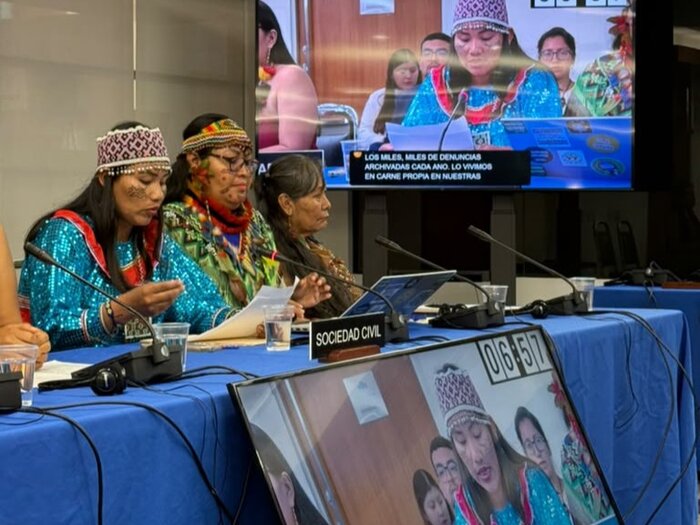
Five women leaders from Indigenous communities in the Peruvian Amazon took part in a thematic hearing organised by the Inter-American Commission on Human Rights (IACHR) to highlight the violence against women defenders of indigenous territories caused by the spread of illegal economies such as drug trafficking, illegal mining, logging and land grabbing.
The regional thematic hearing, entitled ‘The Situation of Indigenous Women Defenders in Contexts of Illegal Economies’ (PS 196-2046), took place on 4 August 2026 in Washington, DC, during the 196th session of the IACHR.
Representing the women leaders and representatives of the Indigenous Peoples of the Peruvian Amazon were Teresita Antazú López, from the Inter-Ethnic Association for the Development of the Peruvian Rainforest (AIDESEP); Elaine Shajian Shawit, from the Regional Co-ordinating Committee of the Indigenous Peoples of San Lorenzo (CORPI-SL); Matut Impi Ismiño, from the Awajún Autonomous Territorial Government (GTAA); Olivia Bisa Tirko, from the Autonomous Territorial Government of the Chapra Nation; and Kelly Valera Silva, from the Regional Organisation of Indigenous Guards of the Shipibo-Konibo-Xetebo People (ORGI).
This hearing at the IACHR took place following a collective petition submitted by AIDESEP, the Alliance for the Sacred Amazonian Watersheds, the Pachamama Foundation, the Episcopal Commission for Social Action (CEAS), Forest Peoples Programme and the Institute for Legal Defence (IDL), with additional support from the Rainforest Foundation US, the Indian Law Resource Centre, the Amazonian Frontiers Association (AFRONTA), CooperAcción and the Water Protector Legal Collective for the delegation of women leaders’ travel.
Representing the IACHR were: Andrea Pochak (First Vice-President of the IACHR and Chair of the hearing), Marion Bethel (Special Rapporteur on Peru and women’s rights), Riyad Insanally (Special Rapporteur on the rights of Indigenous Peoples) and María Claudia Pulido (Deputy Executive Secretary).
A context of constant threats
“Today, we, five women leaders and Indigenous defenders, stand before you to denounce the grave situation we face as a result of the advance of illegal economies that violate our rights and put our territory at risk (…) In the Peruvian Amazon, drug trafficking, illegal mining, illegal logging and land grabbing are on the rise, leading to the invasion and dispossession of our territories, which affects us as Indigenous women defenders and leaders,” said Teresita Antazú.
Leader Teresita Antazú of AIDESEP recalled the tragic case of the murdered leaders of the Asháninka Indigenous community of Alto Tamaya Saweto in the Ucayali region, and the climate of impunity and the long quest for justice by the widows, in the face of neglect by the State. Reference was also made to the Asháninka community of Nueva Austria in the Huánuco region and its ongoing legal uncertainty.
Antazú made special mention of the pro-crime environment in the country, which was facilitated by the legislative branch of the previous government. She highlighted the so-called Anti-Forestry Law, which facilitates illegal activities and the invasion of territories, the continuation of the Comprehensive Mining Formalisation Register (REINFO) and the so-called APCI Act (Peruvian Agency for International Cooperation), which encourages the criminalisation of the defence of Indigenous rights.
Activities disguised as lawful linked to illegal activities that violate Indigenous Peoples’ rights
Olivia Bisa also reflected on how certain activities considered legal affect women and their territories, whilst coexisting with illegal ones:
“In our territory, extractive activities are linked to illegal activities. Both bring invaders into our lands. Criminal networks do not arrive alone; they coexist. In the Amazon, oil extraction has paved the way for invaders engaged in illegal logging, mining and drug trafficking. And with that comes human trafficking, the spread of disease and violence.”
In this regard, Elaine Shajian of CORPI SL called on the Peruvian State to declare null and void the oil, mining, gas and infrastructure concessions that overlap with indigenous territories, without having respected the right to consultation and free, prior and informed consent.
Matut, a leader of the GTAA, also highlighted the context in which the State grants rights to third parties—such as mining concessions in the Amazonian rivers—and how these end up coexisting with illegal economies that become entrenched in indigenous territories.
“Third parties exploit and abuse women to gain access to the territories, and there has been an increase in sexual violence against Indigenous children and adolescents, as well as in human trafficking; as a result, our people are at risk due to the high rate of HIV/AIDS transmission,” said Matut.
State neglect
Olivia Bisa described how, when complaints are made to the state, excuses are made, and it falls to the Indigenous Peoples themselves to organise to defend their lives.
“When we have gone to report incidents, we are told there is no budget to go and confront the situation or take immediate action (…) The Peruvian state is not prepared to save the life of a threatened women’s rights defender. It only acts to collect the bodies, or when we have been silenced or have disappeared,” said Bisa.
For her part, ORGI leader Kelly Valera spoke of the various threats facing the Shipibo communities, as well as the Kakataibo people, and of the neglect they suffer:
“The police do not take action; the police stations are far away in the cities and lack boats, vans or computers. These are not exaggerations; they are facts.”
Valera also highlighted the role played by Indigenous guards as a mechanism for territorial self-protection and for administering Indigenous justice.
Criminalisation
The Indigenous women leaders stated that they are on the front line in the fight against illegal economies, but that in return they have been criminalised by the state.
“It’s not easy to come here and say that we’re being persecuted, that we’re being criminalised, that we’re living under house arrest. To come and say: ‘We want to live freely in our territories!’” said Olivia Bisa.
Kelly Valera called on the Intersectoral Mechanism for the Protection of Human Rights Defenders to recognise criminalisation as a source of risk and to approve guidelines ensuring that the Peruvian National Police work directly with Indigenous organisations and defenders whilst respecting their autonomy.
Gender-specific violence
For her part, Apu Kelly emphasised the need to highlight and address these aspects of gender-specific violence suffered by women human rights defenders:
“Violence does not affect men and women in the same way. We are discriminated against for exercising leadership, leaving the house and speaking out.”
Leader Elaine Shajian also spoke of the impact of the lack of access to justice on Indigenous women, as it is they who always end up seeking it.
Calls to the State and the IACHR
Among the specific demands made by the five women leaders, the following were highlighted: the eradication of illegal mining in coordination with Indigenous Peoples and nationalities; the repeal of pro-crime laws; ensuring effective access to justice; demanding the immediate arrest of the perpetrators of the Alto Tamaya Saweto crime; collective reparations for the families and communities of murdered leaders; the establishment of protection measures for women seeking justice; formal recognition of self-protection mechanisms such as Indigenous guards and the Amazonian Indigenous Security (SIA); the need to strengthen the cross-sectoral mechanism and secure guidelines on police conduct from the Ministry of the Interior; that regional governments have obligations within the framework of mechanisms for the protection of human rights defenders; that the Ministry of Women and Vulnerable Populations implement comprehensive support for women human rights defenders.
The women leaders were accompanied by Rocío Trujillo, a lawyer with AIDESEP; Gisela Loayza, from Cuencas Sagradas; Marité Bustamente, from CEAS; and Álvaro Másquez, from IDL, who elaborated on the requests made to the IACHR.
The State’s response
The Peruvian State was represented by the Ministry of Women, the Ministry of the Interior, the Ministry of Justice, RENIEC, the Intercultural Public Prosecutor’s Office, the Presidency of the Council of Ministers and others.
Broadly speaking, the State outlined the actions it considers appropriate for tackling the illegal economies affecting these territories, the policies designed to safeguard the individual and collective rights of Indigenous women, and the protective measures within the framework of the intersectoral mechanism for the protection of human rights defenders. Among the contributions, the Ministry of Justice’s candour stood out when it stated that protection measures are essential but, to date, do not resolve the structural causes.
Reactions from the IACHR
Marion Bethel, Special Rapporteur on Peru and women’s rights, acknowledged the courage of the Indigenous women leaders in giving their testimonies, adding that the State must strengthen its actions and mechanisms to tackle, in practice and not merely on paper, the illegal economies that threaten women human rights defenders. Riyad Insanally, Special Rapporteur on the rights of Indigenous Peoples, pointed out that the cross-sectoral mechanism might be insufficient, as it does not address the eradication of the illegal economies that affect the livelihoods of Indigenous Peoples. María Pulido highlighted the importance of assessing the situation of cross-border communities. Finally, President Pochak noted that the State’s measures would continue to be insufficient in the face of the serious violations that persist. She did, however, acknowledge the State’s goodwill in agreeing to an on-site visit by the IACHR to Peru.
Overview
- Resource Type:
- News
- Publication date:
- 5 August 2026
- Region:
- Peru
- Partners:
- Asociación Interétnica de Desarrollo de la Selva Peruana (AIDESEP)