

The future of Indigenous territorial rights in the hands of Peru’s Constitutional Court: Kichwa community of Puerto Franco awaits landmark ruling
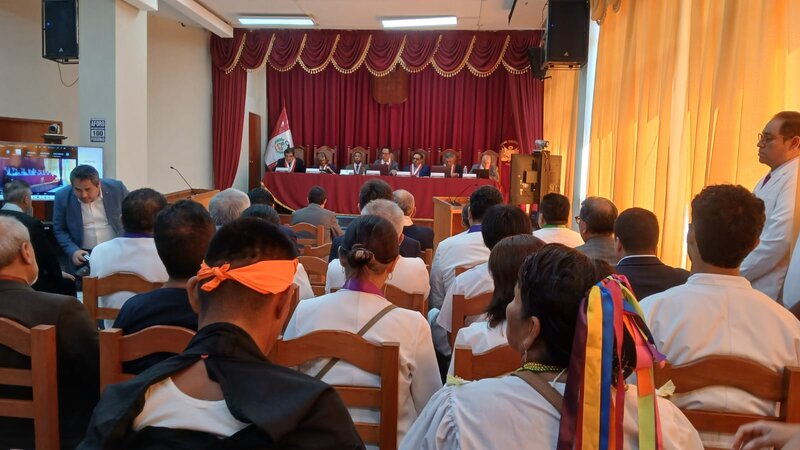
At a hearing in the city of Iquitos, the Constitutional Court heard the arguments of the Kichwa Indigenous Community of Puerto Franco and its federation, CEPKA. They are fighting for recognition of their ancestral territory in the face of an exclusionary conservation model that denies their territorial rights.
On Friday 17 July 2026, Peru’s Constitutional Court held a decentralised public hearing in the city of Iquitos, in which the Puerto Franco Indigenous Community and the Ethnic Council of the Kichwa Peoples of the Amazon (CEPKA) took part. They have been demanding that the State recognise and grant title to the community’s ancestral territory, which currently overlaps with the Cordillera Azul National Park (PNCAZ) and forestry concessions for timber extraction.
During the hearing, Pedro Fasabi, the apu (leader) of the Puerto Franco Indigenous community, was emphatic in reminding the court’s seven judges of the State’s justifications for refusing to recognise their ancestral territory: “(…) They make it seem as though we’ve only just arrived. Puerto Franco dates back to 1940. And I was born and raised in Puerto Franco. They have decreed or established forestry concessions and protected areas without consulting us beforehand.”
He also emphasised the community’s specific request: “We are asking for our territory to be recognised and for us to be granted title to the land we hold.”
Community leader Elina Salas reminded the court of the symbolic and spiritual importance of the communal territory: “We want to be granted title to our territory. That is where our market is. My grandparents took us there to fish and hunt; we are not going to lose that, as it is only natural that we are there. Perhaps we will die soon, but my children will remain, and my grandchildren will remain. It is for them that we are fighting,” she told the judges.
Apu Inocente Sangama, president of CEPKA, criticised the state’s dispossession of Puerto Franco’s territory and reaffirmed CEPKA’s institutional support for its grassroots community. “No prior consultation has taken place. Why have we been discriminated against? Why have we not been taken into account? Do we still believe that we do not exist? Does the State not recognise us? That is why I say to you: we will continue in this common cause, in a constant struggle alongside the people of Puerto Franco.”
In response to the narrative promoted by the State (the National Service of Natural Protected Areas by the State, SERNANP; the Ministry of Environment, MINAM; and the Ministry of Agrarian Development and Irrigation, MIDAGRI) and the NGO, Centre for the Conservation, Research and Management of Natural Areas (CIMA), recently publicised in the press – which alleges the “intangibility” of the National Park to deny indigenous land titling on the pretext that this would destroy the forest – the legal defense team and the experts demonstrated that this constitutes a double standard.
Lawyer Cristina Gavancho, representing the community, presented the Court with arguments for the claim to be upheld and for the effects of the resolution by the Juanjuí Mixed Chamber to be revoked. She also pointed out that the failure to grant title to the territory allowed the imposition, without consultation or free, prior and informed consent, of two timber concessions, a Permanent Production Forest (BPP), and the PNCAZ.
“The preliminary assessments overlooked the Kichwa people by seeking only communities with formal recognition or title. (...) The documents that formed the basis for the recognition of Puerto Franco attest to its presence and affiliation with the Kichwa people since before 1960. And if the initial sketches did not reflect the full extent of the territory – which is what the defendants will point out – this is because they were drawn up at an early stage and without sufficient technical rigour. Such incompetence does not extinguish the ancestral right nor does it relieve the State of its obligation under Article 14.2 of ILO Convention 169 to identify, demarcate and protect the lands traditionally occupied by these peoples,” argued the lawyer.
CEPKA’s lawyer, Juan Carlos Ruiz Molleda, argued that the claim challenges a form of dispossession of Indigenous communities’ territory in the name of conservation and highlighted the need to harmonise rights: “Should we do away with conservation areas? No. They are necessary. They are important. What needs to be done? Harmonise them. And is there any precedent? Yes. Article 4 of the Protected Natural Areas Act stipulates that ownership must be recognised, but restrictions must be established. There is a ruling by the Inter-American Court of Human Rights in the case of the Kaliña and Lokono Peoples v. Suriname. Do you know what the Court says? Stop viewing these peoples as enemies and potential perpetrators; view them as allies.”
The court hearing was also attended by expert speakers who had submitted amicus curiae briefs for the Puerto Franco case. These included Geraldine Izaguirre, representing the Inter-American Association for Environmental Defence (AIDA) and the Centre for Research on Multinational Corporations (SOMO), and David Lobatón from the Due Process of Law Foundation (DPLF).
Whilst the State denies the Kichwa community title to the land, arguing that the forests are ‘national heritage’, it has permitted the imposition of timber concessions and is operating a multi-million-dollar REDD+ project in the PNCAZ.
Given that the PNCAZ has generated contracts worth millions of dollars from Kichwa territory through a REDD+ project designed in 2008, Izaguirre spoke of the need for states to exercise caution with regard to REDD+ projects, particularly due to the potential impacts on the rights of Indigenous Peoples. Furthermore, she highlighted the Peruvian State’s obligations to adopt safeguards in this regard, based on key standards such as the Cancún Safeguards, international human rights instruments, the case law of the Inter-American Court of Human Rights, and even a recent landmark ruling by the Colombian Constitutional Court on the matter.
Lobatón emphasised the right of Indigenous Peoples to collective property and argued that a protected natural area, such as the PNCAZ, should not entail the denial of property rights, reiterating the idea that this presents a historic opportunity for the Constitutional Court to weigh up the issues in the Puerto Franco case.
On the defendants’ side were the head of the PNCAZ, and the legal representatives of MINAM, MIDAGRI, CIMA – the NGO that administers the PNCAZ – and logging company Agrupación Maderera Alto Biavo S.A.C. Their arguments were the same as those put forward in the first and second instances of the court proceedings.
For example, SERNANP stated that, based on participatory processes and technical studies available at the time, the PNCAZ was established without any overlap. MINAM argued that the harmful act was not justified and that the community has only had legal personality since 2016. However, it was unable to respond when the Constitutional Court asked for the state’s position on whether or not it recognised the pre-existence of Indigenous Peoples in general.
Ultimately, the community of Puerto Franco, CEPKA and other Kichwa communities affected by the PNCAZ remain attentive to the final ruling that the Constitutional Court may hand down, which is expected to reaffirm this historic opportunity for Indigenous Peoples to set out on the path towards a model of environmental conservation that includes the Indigenous Peoples of the Amazon.
A decision is expected in the coming months.
Overview
- Resource Type:
- News
- Publication date:
- 22 July 2026
- Region:
- Peru
- Partners:
- Consejo Étnico de los Pueblos Kichwa de la Amazonia (CEPKA)