

Women protecting the territory: The Shipibo Indigenous Guard
FPP spoke with two women leaders who have overcome barriers to join the Indigenous Guard, Kelly Sabrina and Debora Bardales. They talk about their experiences and their plans for the future to strengthen their people and their territory.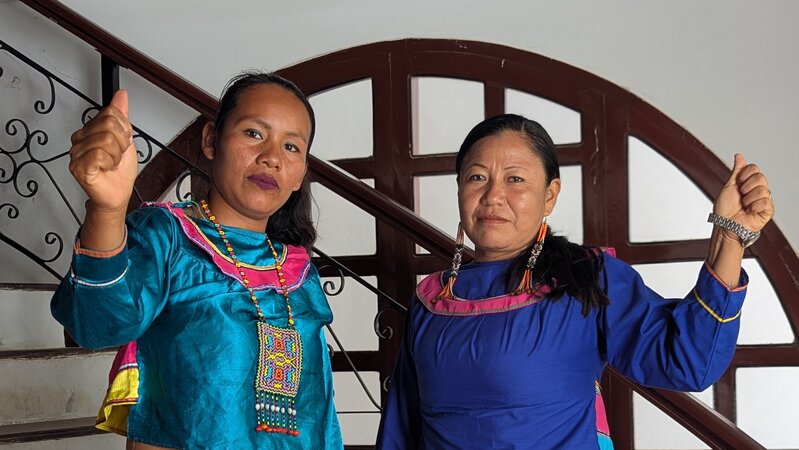
The Indigenous Guard is an initiative of the Shipibo Konibo Xetebo people in the Peruvian Amazon, which exists to protect their territory from extractivism (both legal and illegal). Mining, logging, fishing, and other unregulated activities put their health and that of their lands at risk.
FPP spoke with two women leaders who have overcome barriers to join the Indigenous Guard, Kelly Sabrina and Debora Bardales. They talk about their experiences and their plans for the future to strengthen their people and their territory.
Why does the Indigenous Guard exist?
Kelly: The Indigenous Guard is very important to us. It protects our forests, lakes and fish from invaders who come and want to take everything. We don't want them to take everything, to destroy everything, to leave us with nothing.
Debora: Some of the most serious threats are drug traffickers and fishermen, illegal logging, and land traffickers. All of these are threats.
Kelly: The forest is very important to us. It is our life – our market, our medicine, our hospital too. From the market, we earn money to educate our children.
It is important to protect the forest because it is not only for us, but also for our children. We have to protect it to leave it to them. And if we don't protect it, then who will? No one. What will become of our future generation? So, for us it is very important to protect that, which is our source of life.
"If we don't protect it, then who will? No one."
Debora: We prevail because we are from the forest, as Shipibo. We value the forest greatly.
Why did you decide to join the Indigenous Guard?
Debora: When I was a child, I saw how things were going, our cultures disappearing more than anything else. But even so, as we still live here, we have to protect. As long as we live, we have to fight.
I once said to myself, 'One day I'm going to do something to protect my community, my territory. To help each other. To fight as the Shipibo people, as one heart.' And I fulfilled my dreams.
We are women too, and we have the ability to protect. And the people at the highest levels also treat us as women, and that is why I decided to join the Indigenous Guard with all my heart, to be able to help others, my Shipibo brothers and sisters.
"As long as we live, we have to fight."
Kelly:
Because I have seen many problems. I saw that in my community of Nuevo Oriente de Chanajao, these invaders, these fishermen, illegal fishermen who have been here for a long time, were coming in. Not just one, but several, and so they take part of us away.
It made me angry because they were destroying our fish. And one day I said to myself, 'What do I have to do? What can I do to stop this?' So, we went to the Indigenous Guard. We heard that we can do something. It is about being autonomous, for our own protection.
Are there many women in the Indigenous Guard?
Debora: In the Indigenous Guard, we have seen very little participation by women, and there are several reasons, for example, husbands who are a little machista. But you also have to look at it from another perspective, because even though we have the capacity to face things, we also give in, at least to our husbands, or because of a lack of explanations or training and all that.
In reality, I was also in that situation. But I broke away from all that and felt that I had to value myself. And we are also equal to our husbands. We have the same ability to face things and fight as an indigenous people.
"We have the ability to face things...but we are limited by a lack of explanations or training."
Kelly: We see very little participation from Shipibo women, so we have to provide more training to help them overcome that. We have the same capacity as men.
Sometimes men don't let them either. I don't know how men, out of jealousy, or because we have to look after their children. I know it's difficult, but when you really want something, you find a way. Right? Or it's a matter of depending on our partners — no more, we need to get out of that mentality. We have the same rights as they do.
What can be done to encourage more women to join the guard?
Debora: We set up these schools with women leaders to talk a little about sexual violence, about women's issues, to open the minds of each of the women who are going to participate. We have thought about it with Kelly and the others on the board of directors, and we have talked to the president, who is also part of it. So that we can set up a school in every community that asks us to.
Kelly: These schools would help us a lot to empower women. To give them more encouragement and support. To tell them that we were in the same situation. We can't just stay there looking after our husbands. We value ourselves, don't we? And we do a lot of things too. Just like men. And then we tell our sisters to go ahead and do it.
That's what we want, but we lack logistical support, all that. To give these talks, to open the minds of our sisters. Some say 'yes, I can', some stay because they are ashamed, all that. I've been like that too, but whenever I go, I'm going to explain that, that we can move forward.
Yes, to encourage our Shipibo sisters not to stay where they are, to rise above all that.
How do you feel about being part of the Indigenous Guard?
Debora: We feel proud of everything we have broken down, what it meant for us. And we feel everything. We can do it. We have the ability.
As a woman, I feel proud. In the Indigenous Guard, I also feel that I have the same capacity as the men, and perhaps we are not equal to them. But we have the capacity, just like the men. And I feel very happy supporting the other sisters. Giving them the courage to defend our communities.
"I feel very happy supporting my sisters, giving them the courage to defend our communities."
Kelly: Yes, we feel very proud. At the same time, we feel brave, and that gives us more strength to continue in other communities, right? And to say, "You know what, Shipibo sister? I am proud to defend my territory." And let's keep going. I'm moving forward so that others can follow. Not just us, but many women leaders who can come forward to defend territories.
What would happen if the Indigenous Guard did not exist?
Kelly: It would be chaos. These fishermen come, they take away lots of fish, they cut down the trees. There's nothing left. I mean, it would be bad. And with the Indigenous Guard that we have, we put a stop to it, we protect everything that's beautiful. I think it would be for our future generations - what are they going to live on if there are no trees, no fish? It would be very sad.
Debora: In terms of our wood, fish and vegetables running out, it's close, that will happen, I think. But even so, as we still live here, we have to protect it.
As Shipibo, we are not afraid because we live there. We know the reality. Because everything is our market. And we have to look back, our grandchildren are coming, everything gives us the courage to take care of the forest, not only for ourselves, but for all of Peru.
Overview
- Resource Type:
- News
- Publication date:
- 25 September 2025
- Region:
- Peru
