
Differential mapping shapes the Republic of Congo’s draft land tenure decree

Years of groundwork on participatory mapping are reshaping how Indigenous Peoples’ land rights are understood at the national level in the Republic of the Congo, with the country’s first piece of detailed legislation that protects Indigenous Peoples’ land rights in the process of being adopted.
The Draft Decree on Special Measures for Securing Indigenous Peoples’ Customary Land Rights is one of the most significant outstanding implementation decrees not yet adopted under the 2011 Law on the Rights of Indigenous Populations, an advanced draft is now close to adoption.
Underpinning the draft decree is an inclusive approach to participatory mapping that recognises overlapping Indigenous and local community territories and supports joint governance arrangements. The approach was pioneered by FPP in collaboration with the Centre d’Encadrement Communautaire pour le Développement (CECD), the Observatoire Congolais des Droits de l’Homme (OCDH) and the Direction Générale pour la Promotion des Peuples Autochtones (DGPPA).
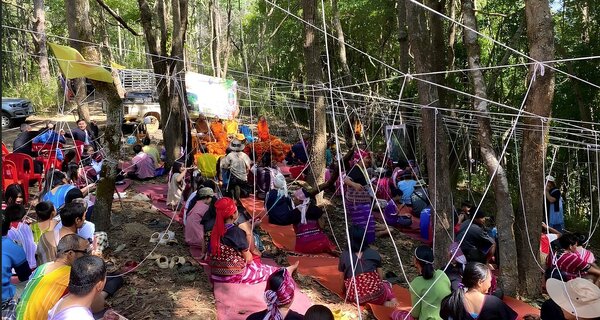
Tested by Baka and Bakwele communities in the Messok-Dja forest landscape in the country’s north, the approach documents shared use, sacred sites and customary boundaries, showing that mapping is not only a technical tool but an instrument of legal recognition and collective self-determination.
In June and October 2025, multi-stakeholder workshops co-hosted by FPP, CECD and OCDH brought together Indigenous leaders, civil society representatives and government representatives to review and refine the draft decree. This engagement continued in December 2025, when CECD, with FPP support, organised a preparatory meeting with Indigenous representatives, on the sidelines of the national validation workshop, to help consolidate Indigenous Peoples’ priorities and support their effective participation in the formal decree validation process held in Brazzaville on 22–24 December.
Through clause-by-clause inputs and a legal gap analysis grounded in field evidence and international jurisprudence, the process has successfully bridged customary systems and national law.
The revised draft decree now enshrines collective tenure recognition, community-led participatory mapping, interim protection of customary lands, and the principles of free, prior and informed consent at every stage. Evidence gathered during the pilots with Baka and Bakwele communities in Messok-Dja was crucial for enabling the DGPPA (the government directorate responsible for Indigenous Peoples within the Ministry of Justice and Human Rights) to integrate these principles into the draft decree. It also includes, for the first time in the country’s legal framework, specific provisions on cohabitation in shared territories.
In another national first, through this collaborative process differential mapping has been formally recognised in the draft decree as a legitimate legal instrument. This sets a precedent for inclusive law-making and for bridging customary practices with formal land administration. Before this process began, the country had no legal mechanism to secure Indigenous customary tenure.
Trust and collaboration between state actors (especially the DGPPA) and civil society actors has also improved through this process, which strengthens the conditions to sustain long-term participation of Indigenous organisations in law-making. A new permanent platform for joint dialogue between the DGPPA and civil society has also been created.
At the community level, the process has increased women’s participation, inter-community cooperation, and awareness of legal rights.
Overall, the process demonstrates that Indigenous land-use systems can be documented, recognised and governed through inclusive, rights-based approaches.
Overview
- Resource Type:
- News
- Publication date:
- 1 October 2025
- Region:
- Republic of Congo
- Programmes:
- Territorial Governance Law and Policy Reform
- Partners:
- The Centre d’Encadrement Communautaire pour le Développement (CECD) The Congolese Observatory for Human Rights (OCDH)
Related news