
Land reform, conservation and Indigenous rights at the heart of Democratic Republic of the Congo talks
In the DRC, a multi-stakeholder dialogue placed the rights of Indigenous Peoples at the heart of reforms relating to land tenure, forestry, land-use planning, nature conservation and sectoral legislation that affects their rights.
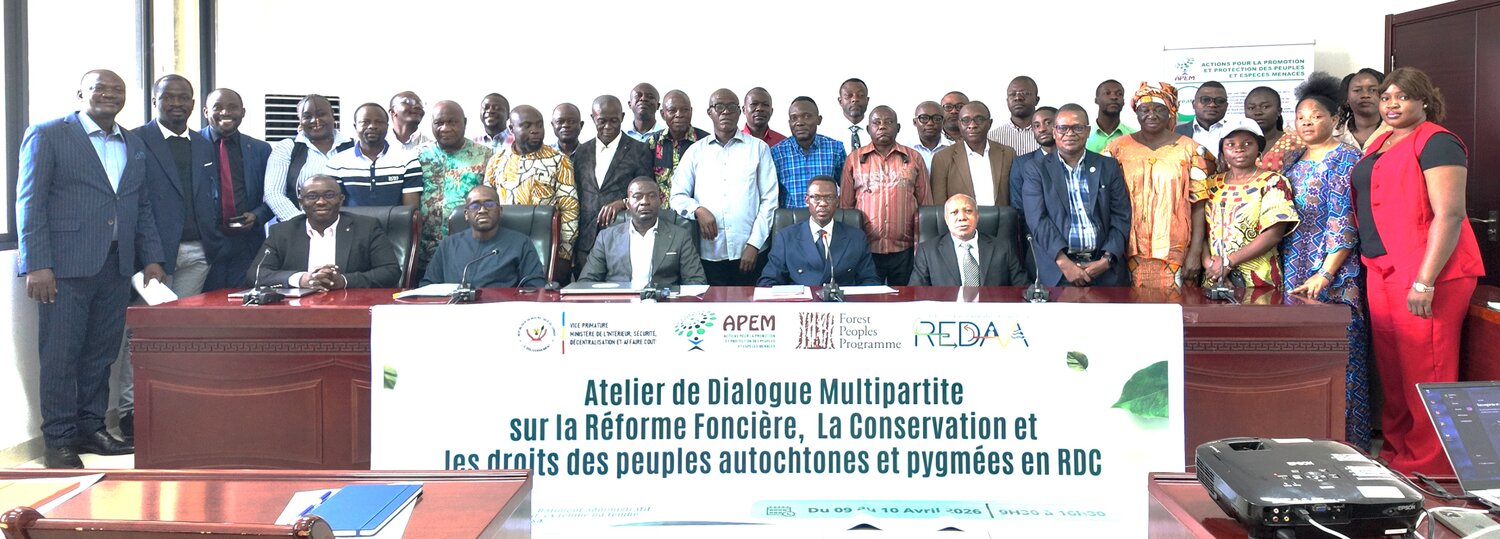
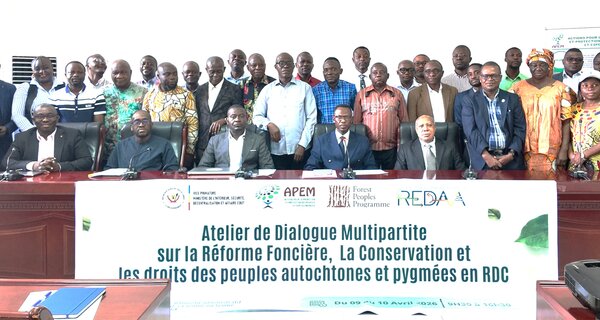
In Kinshasa, on 9 and 10 April 2026, at the initiative of the NGO Actions for the Promotion and Protection of Threatened Peoples and Species (APEM) and the Forest Peoples Programme (FPP), organisations representing Indigenous Peoples, representatives of the public administration, civil society actors, as well as technical and financial partners came together for a multi-stakeholder dialogue dedicated to the future of land, forestry, conservation, land-use planning and forest policy reforms in the Democratic Republic of the Congo (DRC). At the heart of the discussions was a key question:
how can we ensure that these reforms genuinely strengthen the rights of Indigenous Peoples and local communities, rather than undermining them?
Held under the institutional patronage of the Office of the Deputy Prime Minister for the Interior, Security, Decentralisation and Customary Affairs, this dialogue was chaired by the Secretary-General for Customary Affairs, Augustin Mungimi Tiamweni.
The workshop focused on several projects currently underway in the DRC, notably the implementation of Land Law No. 25/062 of 30 December 2025, reforms relating to land use planning (LUP) and forests, implementing regulations concerning consultation and free, prior and informed consent (FPIC) in the context of land use planning, the reform of the Nature Conservation Act, the National Forestry Policy, biodiversity commitments, and the implementation of the 2022 Act on the Promotion and Protection of the Rights of Indigenous Peoples.
Important but unfinished reforms
Participants acknowledged that the DRC is undergoing a significant phase of reforms, which presents opportunities. However, they warned that, without clear, effective and enforceable safeguards and guarantees of rights, these reforms could also exacerbate land insecurity, overlapping of land use, conflicts and the marginalisation of the communities concerned. They thus reaffirmed that customary rights, Free Prior and Informed Consent (FPIC), effective participation, redress and shared governance must precede any decision on land allocation, conservation or investment.
Land reform was a central focus of the discussions. Whilst the 2025 law introduces advances, particularly regarding preliminary surveys of rural land, equitable access to land and transparency, participants emphasised that uncertainties remain regarding the status of community lands, their security, the effective consideration of Indigenous Peoples and the operationalisation of FPIC.
Conservation, redress and next steps
Participants also reiterated that any credible conservation reform must learn from the case of Kahuzi-Biega National Park. The decision regarding the Batwa of Kahuzi-Biega National Park (PNKB) issued by the African Commission on Human and Peoples’ Rights serves as a reminder that conservation cannot justify eviction, dispossession or exclusion. On the contrary, it calls for restitution, reparation, recognition of territorial rights, FPIC, effective participation, co-management and guarantees of non-repetition.
With this in mind, participants called on the ICCN and WCS to accelerate, in coordination with the CNDH, the implementation of this decision through an independent, inclusive and transparent mechanism that effectively involves the communities concerned, the applicants and organisations supporting the Batwa.
Finally, the discussions highlighted the need to better coordinate reforms with one another. Persistent contradictions between land, forestry, environmental, mining, conservation and land-use planning frameworks continue to fuel overlaps, conflicts and legal uncertainty. Participants thus emphasised the importance of stronger cross-sectoral coordination, as well as the need to ensure that forestry, biodiversity and conservation policies remain fully compatible with rights, effective participation and the equitable sharing of benefits.
At the end of the workshop, participants recommended that the workshop report resulting from the discussions be finalised and forwarded to the relevant authorities. The main conclusions of the dialogue were also set out in a final communiqué adopted at the end of the discussions.
Aperçu
- Type de ressource:
- News
- Date de publication:
- 12 mai 2026
- Région:
- République démocratique du Congo (RDC)
- Programmes:
- Gouvernance territoriale Conservation et droits humains Autonomisation juridique Réformes juridiques et politiques
- Partenaires:
- Actions pour la Promotion et Protection des Peuples et Espèces Menacés (APEM)