
Healing an Oil Palm Landscape in Indonesia
This report is also available in Bahasa Indonesia
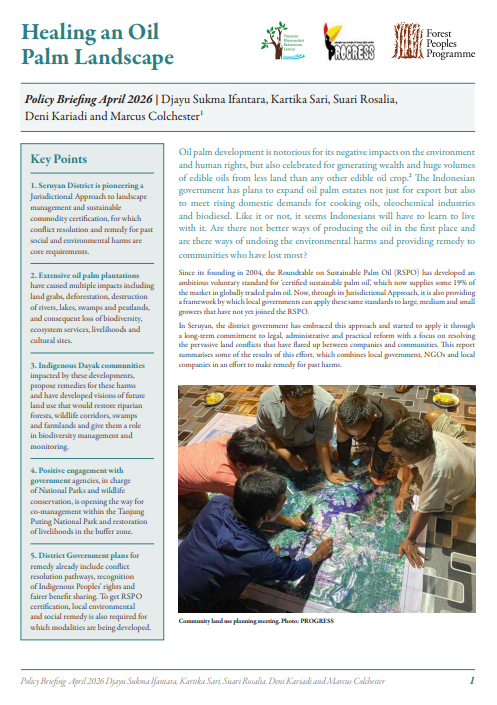
Oil palm development is notorious for its negative impacts on the environment and human rights, but also celebrated for generating wealth and huge volumes of edible oils from less land than any other edible oil crop.
The Indonesian government has plans to expand oil palm estates not just for export but also to meet rising domestic demands for cooking oils, oleochemical industries and biodiesel. Like it or not, it seems Indonesians will have to learn to live with it. Are there not better ways of producing the oil in the first place and are there ways of undoing the environmental harms and providing remedy to communities who have lost most?
This briefing focuses on Seruyan Regency, Central Kalimantan, Indonesia, where the local government has adopted a new approach to work towards sustainable palm oil certification, based on a new framework from the Roundtable on Sustainable Palm Oil (RSPO).
Since its founding in 2004, the RSPO has developed an ambitious voluntary standard for ‘certified sustainable palm oil’, which now supplies some 19% of the market in globally traded palm oil. Now, through its Jurisdictional Approach, it is also providing a framework by which local governments can apply these same standards to large, medium and small growers that have not yet joined the RSPO.
In Seruyan, the district government has embraced this approach and started to apply it through a long-term commitment to legal, administrative and practical reform with a focus on resolving the pervasive land conflicts that have flared up between companies and communities. This report summarises some of the results of this effort, which combines local government, NGOs and local companies in an effort to make remedy for past harms. Using this framework, wider landscape remediation is also underway to ensure communities have secure rights and can manage and control conservation areas and establish wildlife corridors connecting isolated orang utan populations cut off by oil palm plantations from those in the protected areas.
What the communities envision is not just a recognition of their rights, much less a return to the past, but a more diversified use of the land, in which their traditional economies and environment can be restored. This will bring not just more secure incomes and village prosperity but also a restoration of rivers, lakes, forests, and wildlife, mixed economies and multiple crops. Moreover, the majority of community members are not outright rejecting the presence of the oil palm companies, they just want them scaled back, more equitable relationships, properly paid and secure jobs, and their share of the plantings established on their lands.
Aperçu
- Type de ressource:
- Reports
- Date de publication:
- 22 avril 2026
- Région:
- Indonésie
- Programmes:
- Chaînes d’approvisionnement et commerce
- Partenaires:
- Palangkaraya Ecological and Human Rights Studies (PROGRESS) Yayasan Masyarakat Kehutanan Lestari (YMKL)